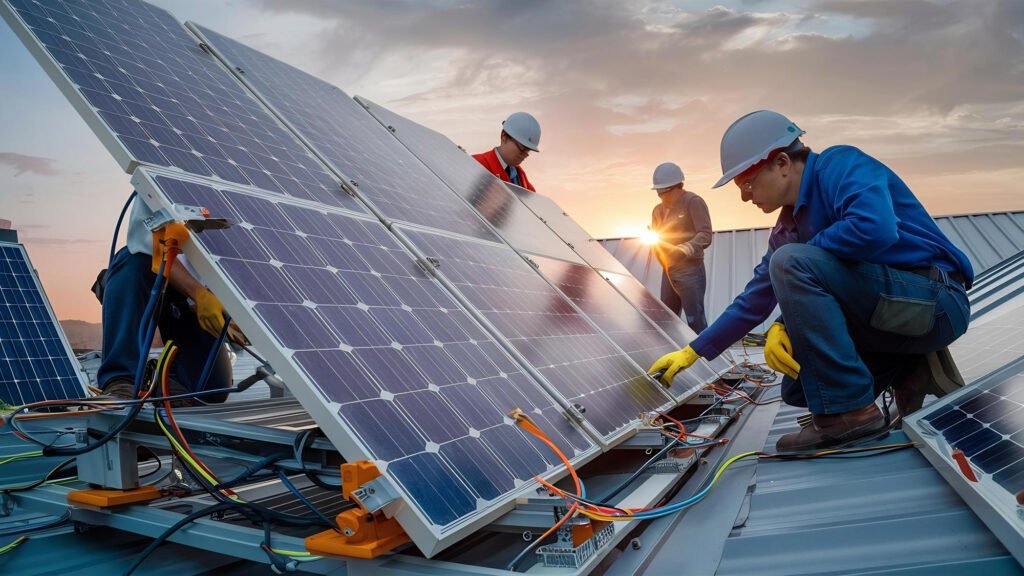
We don’t just install solar — we support it, fix it, protect it, and extend its life . Whether your system needs a repair, your installer disappeared, or pests moved in under your panels, we handle it.
Explore the full range of services designed to keep your solar investment running smoothly, backed by local experts who pick up the phone and show up when you need us.
Very professional and reliable service. The installation was completed on time, the workmanship was neat, and the system has been performing perfectly. Highly recommend them to anyone considering solar energy.
Jessica M.
San Jose, CA
Switching to solar was one of our best decisions. The team made the entire process smooth and stress-free. We’re already seeing great savings, and it feels good to use clean, renewable energy.
David Wolf
Brooklyn, NY
What impressed us most was their transparency and support. They guided us through system selection, approvals, and installation without any hassle. The after-sales service has also been prompt and helpful.
Greg Davis
Brooklyn, NY
Excellent service and great attention to detail. The installation was well-planned, completed on schedule, and the system is working flawlessly. We truly appreciate their professionalism and commitment to quality.
Do solar panels need bright sunshine in order to work?
A space-based solar power system in a geostationary orbit would appear stationary in the sky to a ground observer but would track across the starfield as the Earth turns. The solar power satellite design intentionally maximises the collection of sunlight, rather than reflecting it to Earth.
Despite the large size of the solar power satellite, because of the high orbit its visual angle when viewed from earth is less than 1/5 of the International Space Station (currently the largest satellite orbiting earth).
The capabilities needed for space-based solar power, including low-cost space access, could also facilitate further space-based astronomy, or systems located on the RF-quiet far-side of the Moon.
Is solar energy expensive to produce?
According to the International Energy Agency, there are some circumstances where solar photovoltaic (PV) is now the cheapest electricity source in history.4 This is because the price of solar has fallen sharply around the world – including in the UK, where the cost of installing solar panels has decreased by 60% since 2010.5 The efficiency of solar panels and other system components also continues to improve.
Don’t solar farms take up large areas of land that could be used for farming?
As solar parks generate income, they provide UK farmers with a revenue stream to continue food production on their land and support other aspects of their agricultural business. Plus, solar farms can actually help to give intensively farmed land an opportunity to recover, while still providing income for the farming business.
Does solar panel manufacturing produce more carbon emissions than the panels save over their lifetime?
No. In fact, solar projects save thousands of tonnes of carbon emissions over their lifetime.
While some carbon is emitted in the manufacture of solar panels – as with all manufactured products – claims that solar panels produce more carbon than they save are false. Research has shown that the carbon payback period for solar panels is on average 1-4 years.9
This means that over a solar panel’s lifetime – typically 30 years10 – it will generate zero-carbon and zero-pollution electricity for decades after any carbon emitted during its production has been paid back.